

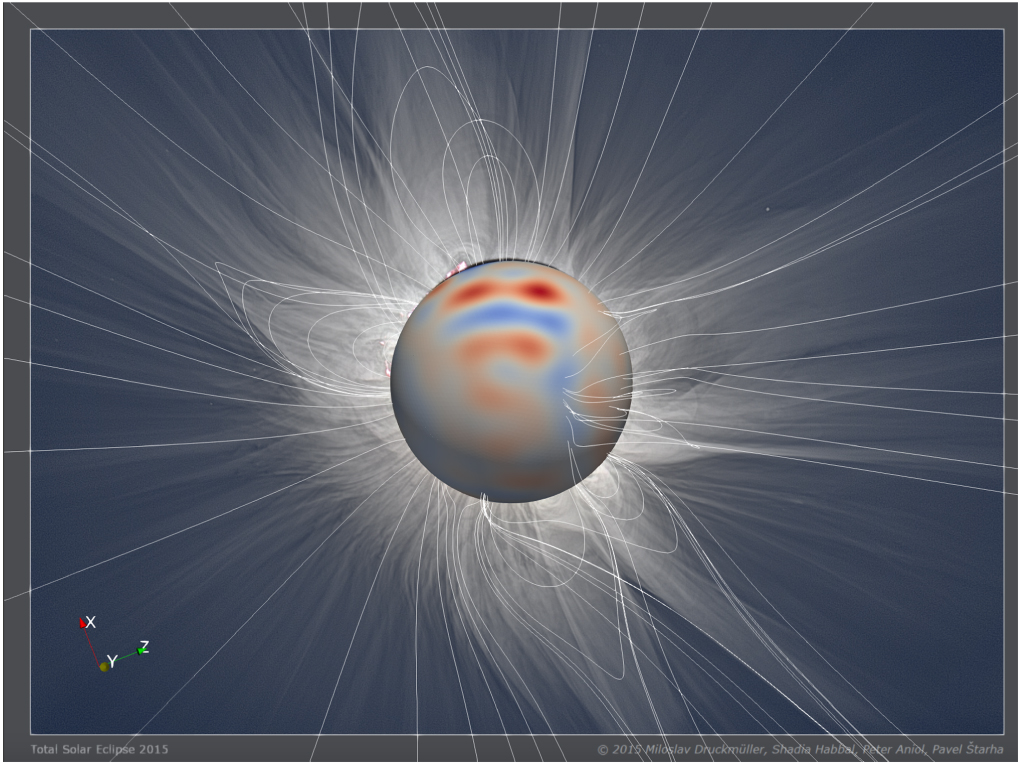
COCONUT
COCONUT is a 3D magnetohydrodynamics (MHD) coronal model that is implemented in the framework of COOLFLuiD. Driven by photospheric magnetograms, COCONUT simulates the solar corona up to 25 R☉. The optimized design of the model, namely the unstructured grid and fully implicit solver guarantees fast simulations, suited for space weather forecasting timeframe. The model can be driven both in steady and time-evolving regimes. The high resolution grid in the low corona (<4 R☉) allows to resolve fine structures near the solar surface, which can be compared to the total solar eclipse images
Q Factor
The Sun is a giant magnet, and its outer atmosphere is threaded by invisible magnetic lines that guide the glowing gas, much like iron filings around a bar magnet. These images make those threads visible: each bright line is a border where the magnetic threads abruptly change where they go. The rays and streamers seen during a total eclipse form along exactly these borders. The images are made with Qorona⊥, which follows millions of magnetic field lines through the corona simulated by COCONUT and lights up the places where neighbouring lines pull apart most strongly. The number used to measure that is called the squashing factor Q, which gives the images their name. The colours are simply an aid to the eye: warm tones hug the Sun, cooler blues pick out the structures reaching higher above it.
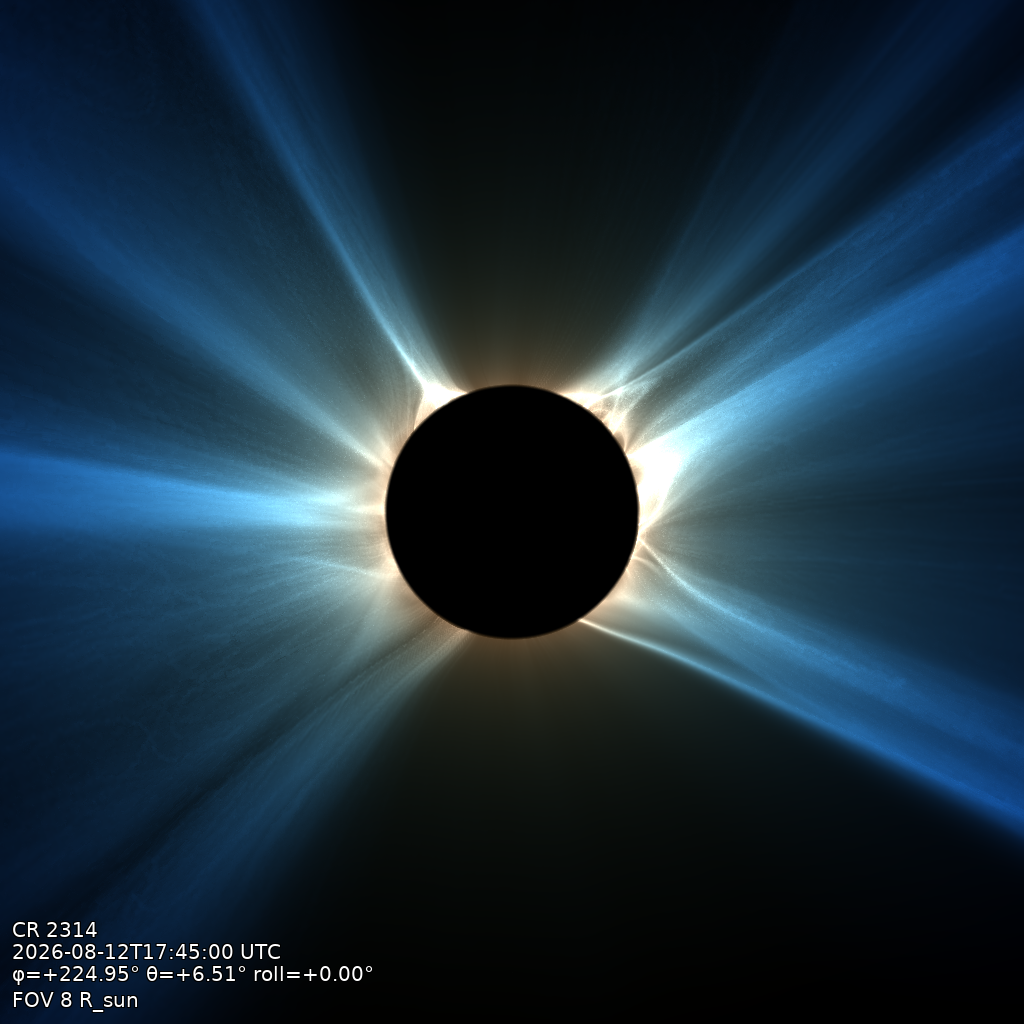
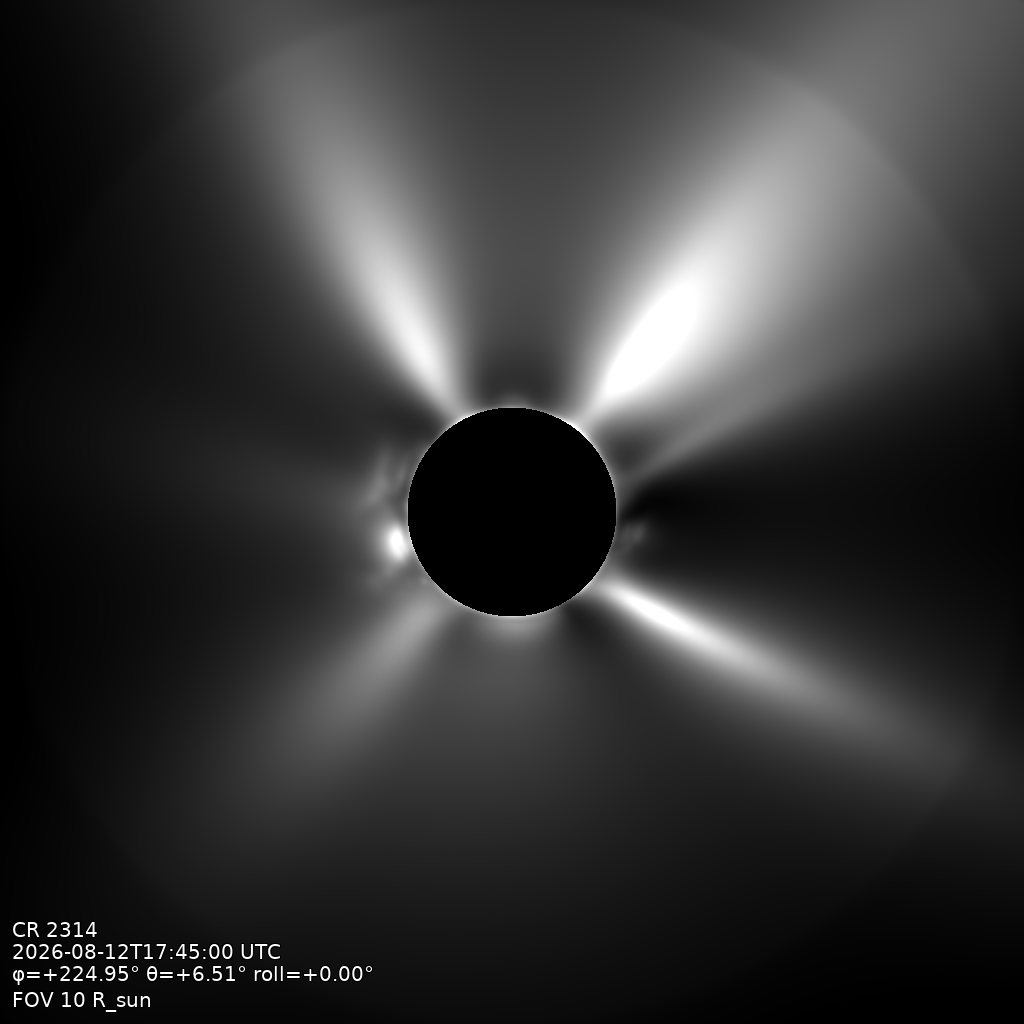
The corona in white light
These images map the density of the corona. Coronal gas scatters ordinary sunlight towards us, and the more gas there is along the line of view, the brighter the picture: bright streamers are dense sheets reaching into space, dark regions are where the corona is thin. This same scattered sunlight is what the naked eye sees during totality, which is why they are called white-light images. In reality the corona fades quickly with distance from the Sun. The synthetic images produced are filtered to even out that fading, just as photographers do with real eclipse pictures, so the faint outer streamers stay visible next to the brilliant inner corona.
Total solar eclipse predictions
Total solar eclipse is a unique opportunity to observe the solar atmosphere. The Sun is so bright, it is impossible to see fainter structures present in the solar corona, however, these faint structures represent the magnetic field configuration of the Sun. Understanding processes in the solar corona is crucial for solar and helio-physics, as their impact extends to our planet and farther in the heliosphere. Total solar eclipse image is an ideal for validating coronal models. For this aim, we have started predicting the configuration of the solar eclipse 27 days before the totality, which allows us to observe how much the Sun changes overtime. Procedure: Everyday we retrieve the latest photospheric magnetogram observations à process the magnetogram à perform COCONUT simulation with this input à Process output of COCONUT with Qorona à Publish results


Eclipse Predictions Team
This work has been carried out thanks to a close collaboration between the European Space Agency, the univeristy KU Leuven, the Royal Observatory of Belgium, and the Paris Observatory at Meudon.
Learn more
The eclipse predictions presented on this website are based on the COCONUT numerical solar corona model and associated visualization tools. The following resources provide additional scientific and technical details.
-
KU Leuven COCONUT Eclipse 2026 Predictions
Interactive prediction portal for the 12 August 2026 total solar eclipse.
Total Solar Eclipse 2026 Predictions -
Polytropic COCONUT Model
Perri, B. et al., The Astrophysical Journal, 936, 19 (2022).
Open Access DOI: 10.3847/1538-4357/ac7237 -
Full-MHD COCONUT Model
Baratashvili, T. et al., Astronomy & Astrophysics, 690, A184 (2024).
DOI: 10.1051/0004-6361/202449389 -
Energy Decomposition in COCONUT
Wang, H. P. et al., The Astrophysical Journal Supplement Series, 283, 40 (2026).
DOI: 10.3847/1538-4365/ae40b1 -
Qorona Visualization Tool
Dhib et al. (2026), submitted to The Astrophysical Journal.
GitHub Repository